
How to Improve PTE Writing Vocabulary
Jul 23, 2026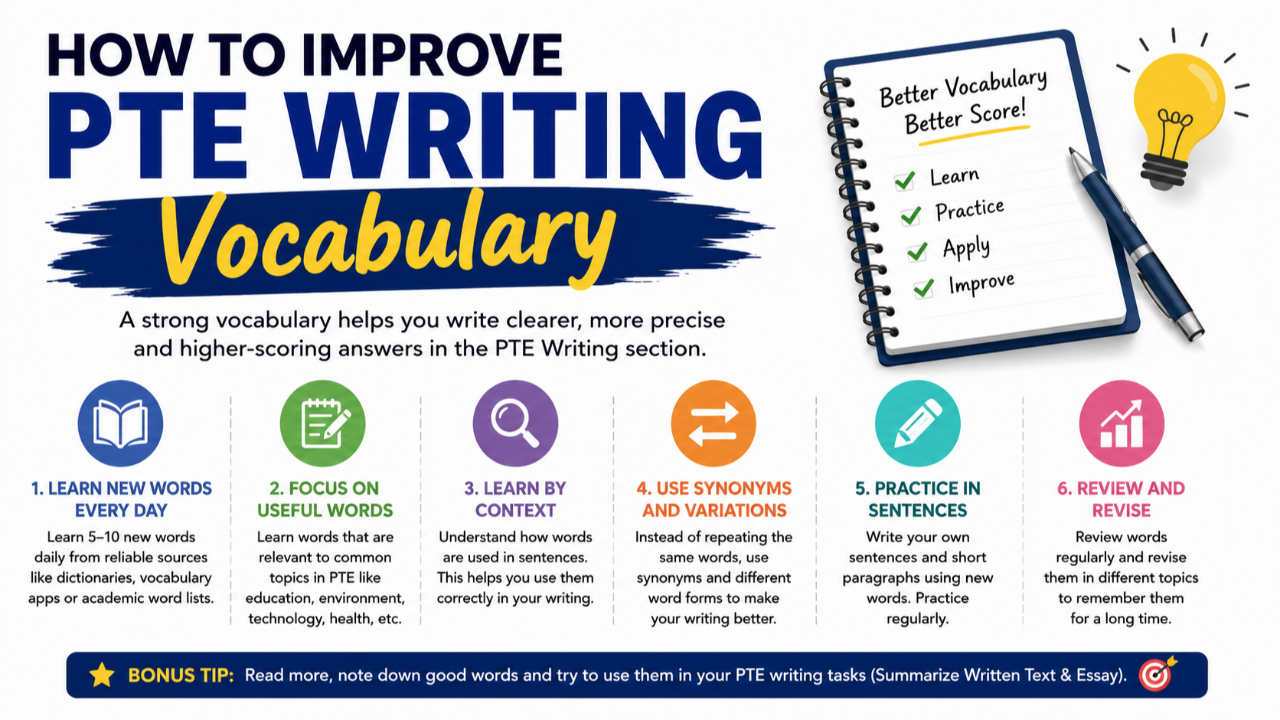
How to Improve PTE Writing Vocabulary
Category: PTE Writing Suggested slug: improve-pte-writing-vocabulary Author display: Sharry PTE Team Reading time: 5–6 minutes Last updated: 2026-07-23
Many PTE students try to improve vocabulary by memorizing long lists of difficult words. This usually does not work. In the exam, you need vocabulary that is accurate, flexible, and relevant to common academic topics. Random advanced words can make your writing sound unnatural or even incorrect.
The best PTE writing vocabulary is practical: words and phrases you can use confidently in essays and summaries.
Why this matters for PTE success
Vocabulary affects how clearly you express ideas. In PTE essays, stronger word choice can improve precision and reduce repetition. In Summarize Written Text, the right vocabulary helps you compress meaning without copying too much from the passage.
However, vocabulary only helps when it is used correctly. A simple word used accurately is better than an advanced word used in the wrong context.
For example:
Weak:
“Technology is very good for students.”
Better:
“Technology provides students with flexible access to educational resources.”
The second sentence is more academic, but still clear.
Step-by-step strategy
Step 1: Learn vocabulary by topic
PTE topics often include:
- Education
- Technology
- Environment
- Health
- Work
- Society
- Government
- Culture
Create topic-based word banks instead of random lists.
Example for education:
- access to education
- academic performance
- learning outcomes
- digital resources
- student engagement
- independent learning
Step 2: Learn phrases, not single words
Words become useful when you know how they connect.
Instead of memorizing “significant,” learn:
- a significant impact
- a significant improvement
- a significant challenge
- significantly affect
This helps you write faster and more naturally.
Step 3: Replace weak repeated words
Students often repeat words like “good,” “bad,” “important,” and “thing.” Build better alternatives.
Examples:
- good → beneficial, effective, valuable
- bad → harmful, ineffective, problematic
- important → essential, significant, crucial
- thing → factor, issue, development, approach
Use alternatives carefully. Do not replace every simple word if the sentence becomes unnatural.
Step 4: Practise vocabulary in full sentences
A word is not truly learned until you can use it in a sentence.
Example:
“Online education can improve learning outcomes because students are able to review recorded lessons at their own pace.”
This sentence uses topic vocabulary naturally.
Step 5: Build connector and academic phrase control
Useful academic phrases include:
- In recent years,
- One major advantage is that...
- This can lead to...
- As a result,
- From a broader perspective,
- This issue is particularly relevant because...
These phrases improve flow and help you write under time pressure.
Common mistakes to avoid
- Memorizing rare words: If you cannot use a word naturally, do not rely on it.
- Using synonyms incorrectly: Similar words can have different meanings.
- Repeating the same phrase in every essay: This sounds robotic.
- Ignoring collocations: “Make a decision” is natural; “do a decision” is not.
- Using vocabulary without grammar control: Good words cannot fix broken sentences.
Another mistake is learning vocabulary without reviewing. Spaced repetition helps words move into active use.
Expert tips from Sharry PTE Team
- Keep a topic vocabulary notebook. Organize by exam themes.
- Write five example sentences for every useful phrase. This builds active control.
- Review your own essays. Replace repeated weak words with better alternatives.
- Learn collocations. Word partnerships make writing sound natural.
- Use vocabulary in timed practice. Exam pressure reveals whether you truly know a phrase.
Premium vocabulary preparation is not about sounding fancy. It is about sounding clear, academic, and controlled.
FAQs
Should I memorize advanced vocabulary for PTE?
Not randomly. Learn useful academic words and phrases by topic, and practise them in sentences.
How many words should I learn?
Focus on quality over quantity. A smaller set of flexible phrases is more useful than hundreds of words you cannot use.
Can vocabulary improve my essay score?
Yes, especially when it improves clarity, precision, and coherence. It must be grammatically correct.
What is the best way to remember vocabulary?
Use topic lists, example sentences, spaced review, and timed writing practice.
Related articles
- Academic Vocabulary for PTE Essays
- PTE Vocabulary List for Common Topics
- PTE Essay Template for High Scores
Join Sharry PTE Elite Program
If you want structure, expert coaching, weekly live classes, mock tests, templates, and a premium student community, join Sharry PTE Elite Program and start your path toward your target score.
Stay connected with news and updates!
Join our mailing list to receive the latest news and updates from our team.
Don't worry, your information will not be shared.
We hate SPAM. We will never sell your information, for any reason.